Serological Pipettes: Choosing the Right Size and Type for Cell Culture Work
By Pipettes Guru
Sizing Up Serological Pipettes for Cell Culture: What Actually Matters
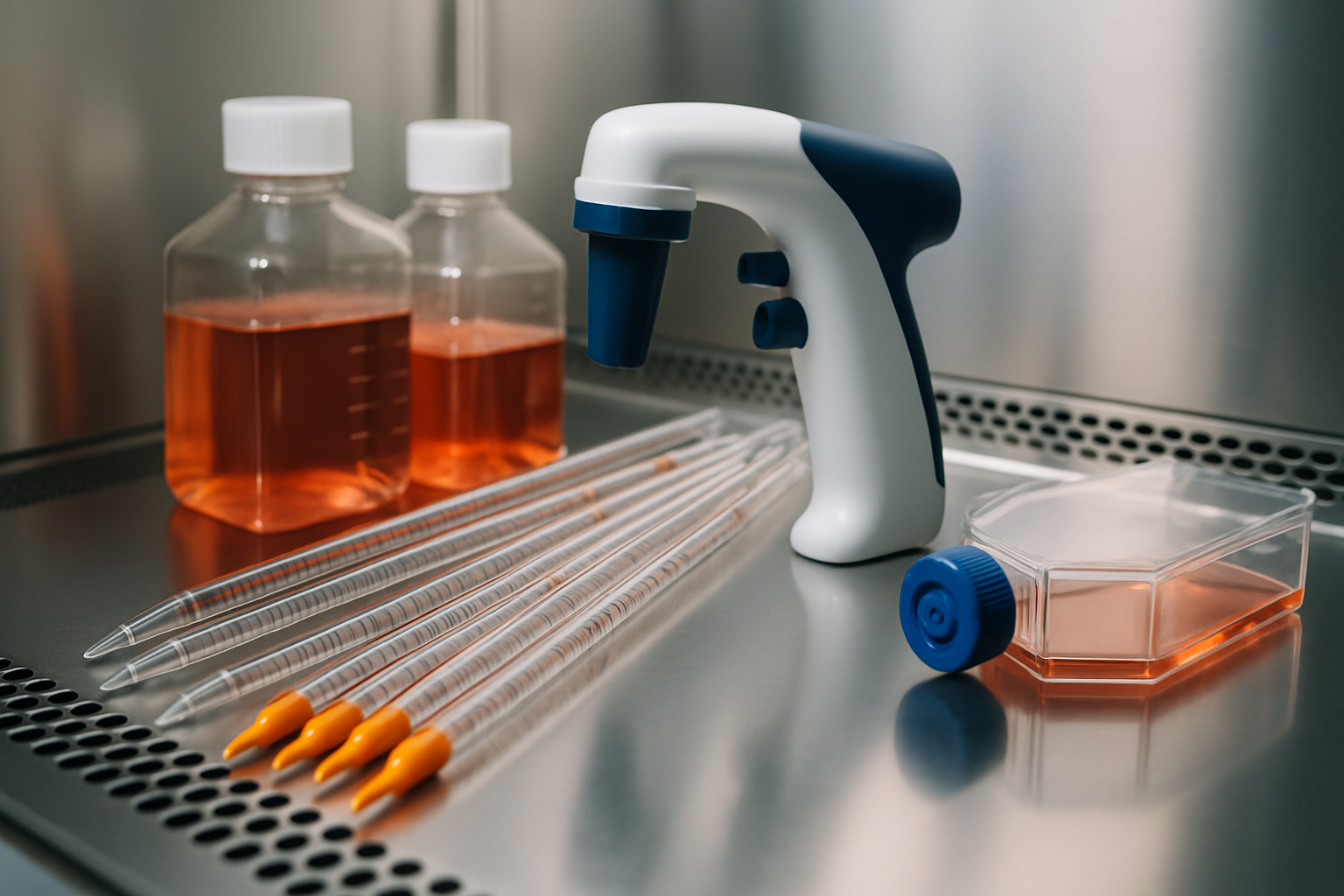
A 25 mL serological pipette sitting on a tissue culture hood next to a T-175 flask — that image probably looks familiar. What's less obvious is why that specific size is wrong for about 40% of the transfers happening in that same workflow. I've watched labs burn through 25s for everything from a 3 mL media change to a 50 mL reagent addition, and the downstream effects — shear stress on suspension cells, inconsistent dosing volumes, contamination risk from repeated aspiration — are entirely avoidable if you match the pipette to the job with any real intention.
Serological pipettes are graduated, disposable (or sterile single-use) pipettes typically manufactured from polystyrene, designed for volumetric transfer of liquids in cell culture, microbiology, and biochemistry. Sizes run from 1 mL through 50 mL, with 2, 5, 10, and 25 mL being the workhorses in most mammalian cell culture labs. The calibration standard most manufacturers reference is ISO 8655-6, which covers piston-operated volumetric apparatus — serological pipettes fall under the family of gravity/aspiration-driven devices and while not regulated under 8655 the same way as air-displacement pipettors, ISO 8655-6 provides the tolerance framework many contract manufacturers align to for consistency claims.
Here's the practical upshot of that: a 10 mL serological pipette dispensing 10 mL should deliver within ±2% of target volume at room temperature. When you're doing a full-volume dispense — say, 25 mL out of a 25 mL pipette — you're typically at ±1.5 to 2%. But partial-volume draws, pulling 3 mL from a 25 mL pipette, can drift 4–6% depending on graduation spacing and operator technique. That's meaningful if your protocol calls for 3 mL of trypsin on a T-25 flask. It's a lot less meaningful for a media wash step where you're dumping 20 mL anyway.
Matching Size to Application: A Practical Framework
The rule I work from: use a serological pipette no more than twice the target volume. If you need 4 mL, use a 5 mL pipette. Need 8 mL, use a 10. Going bigger than 2x increases your error margin and wastes liquid. Going smaller obviously doesn't work unless you're splitting transfers.
For routine cell culture work, here's how I'd break down the size-to-application mapping:
- 1 mL serological: Adding supplements like L-glutamine, antibiotics, or concentrated cytokines to small volumes. Precise. Annoying to use at scale.
- 2 mL serological: Underused and excellent for resuspending a cell pellet after centrifugation — gentle aspiration, controlled volume.
- 5 mL serological: Trypsin addition for T-25/T-75, small reagent transfers, feeding 6-well plates. This is the one I'd never run out of.
- 10 mL serological: Media changes on T-75s, transferring cell suspensions to conical tubes, splitting steps. Most-used size in most labs I've visited.
- 25 mL serological: T-175 and T-225 flasks, spinner flask additions, large-scale reagent prep. Gets over-recruited into 10 mL jobs constantly.
- 50 mL serological: Bulk media preparation, large-format bioreactor additions. Not typical on a standard tissue culture bench.
Sterility matters enormously here. Individually wrapped, gamma-irradiated serological pipettes are the standard for any mammalian cell culture. Look for SAL (Sterility Assurance Level) of 10⁻⁶ — that's on the label if you know to look. Brands like Corning, Greiner, and Falcon all hit this. What varies is aspiration plug integrity and the graduation accuracy at low volumes, which is where cheaper off-brand serological pipettes tend to disappoint.
One thing I'll mention for teaching labs or non-sterile applications like bacterial culture and buffer prep: sterility-extended serological pipettes — units past their labeled sterility date but covered by a manufacturer extension letter — are a legitimate option. We see them priced at 60–80% off standard catalog cost, and for any work where absolute sterility isn't the constraint, they perform identically. The extension documentation is the key. Don't use them without it.
The Cotton Plug Problem (and How Pipette Controllers Factor In)
If your serological pipettes are leaking or aspirating inconsistently, look at the aspiration plug before blaming technique. The cotton or cellulose plug at the top of the pipette creates the seal against your pipette controller. Cheap plugs compress unevenly. They also wick liquid if you aspirate too aggressively, which contaminates the controller and creates a vector for cross-contamination between flasks if people aren't swapping tips between cultures.
This is pipette controller territory, and it intersects with serological pipette choice more than people expect. Controllers like the Integra PIPETBOY acu 2 and Drummond Portable-Boy use different aspiration speeds and pressure profiles. Fast controllers with aggressive fill speeds shear cells harder during aspiration — this matters for primary neurons, cardiomyocytes, or any suspension culture where you're worried about mechanical damage. Slow, manual or semi-manual controllers give more control. The pipette itself doesn't change the physics, but pairing a thin-walled 2 mL serological with a hard-charging motorized controller for neuronal transfers is the kind of mismatch that costs you cells on a Friday afternoon.
Last spring a researcher reached out to us after seeing unusual variability in their T-cell expansion assays — same protocol, same media lot, wildly inconsistent cell counts at passage. After walking through their workflow, it turned out they'd switched from 10 mL to 25 mL serological pipettes (supply issue) and were pulling 8 mL of media at partial volume. The graduation error on partial-volume draws from the 25s was giving them roughly 8.3–8.7 mL instead of 8.0, a 4–8% overage on media volume per well. Dilution artifact. Switched back to 10 mL pipettes, variability resolved. Not a dramatic story. But a real one.
Where Refurbished Pipettors Fit Into a Serological Workflow
Serological pipettes themselves are disposable — no refurbishment question there. But the wider cell culture bench involves air-displacement and positive-displacement pipettors for smaller-volume work: adding serum to media, preparing cytokine dilutions, dosing compounds into wells. That's where certified refurbished pipettes become genuinely interesting from a procurement standpoint.
A refurbished Rainin Pipet-Lite XLS or Eppendorf Research plus, recalibrated against ISO 8655 gravimetric standards and certified to original factory tolerances, costs $80–140 versus $220–350 new. The accuracy spec is identical. At Pipettes Guru, every certified refurbished unit goes through a full gravimetric verification — actual measured water weights at multiple volumes across the range, not just a pass/fail stamp — before it leaves. For a lab manager stocking a new tissue culture suite with 12 benches and 3 pipettors per bench, that's a real budget difference without any accuracy compromise.
The calculation changes if you're working in a GMP or GLP environment where audit trails on instrument history become complicated. For academic research, CRO support labs, and biotech discovery benches, certified refurbished pipettors calibrated to ISO 8655 are the straightforward choice. The serological pipette work is disposable and sterile by design. The rest of the bench doesn't have to be expensive to be accurate.
Pick your serological sizes deliberately. Run the right size for the volume. Don't let supply chain substitutions quietly introduce variability into your data. And when you're sourcing the pipettors that live next to those serological racks — there's no accuracy penalty in buying smart.
Single and multichannel, manual and electronic, every major brand — certified, calibrated and warrantied.
Shop certified pipettes →✓ Free shipping over $500 · ✓ 90-day warranty · ✓ Calibration certificateRelated guides
- How to Choose a Pipette: A Practical Guide (start here)
- Understanding Pipette Specifications: Accuracy, Precision, and What the Numbers Mean
- The Science of Accurate Liquid Handling: Factors Affecting Pipette Performance
- Electronic vs. Manual Pipettes: Making the Right Choice for Your Application
- Reducing Repetitive Strain Injury in the Lab: Ergonomic Pipetting Techniques
Shop the range
Shop certified pipettes · Refurbished single & multichannel · Shop by brand