Filtered, Sterile, Low-Retention: Which Tip Features You Actually Need for PCR
By Marcus Reyes
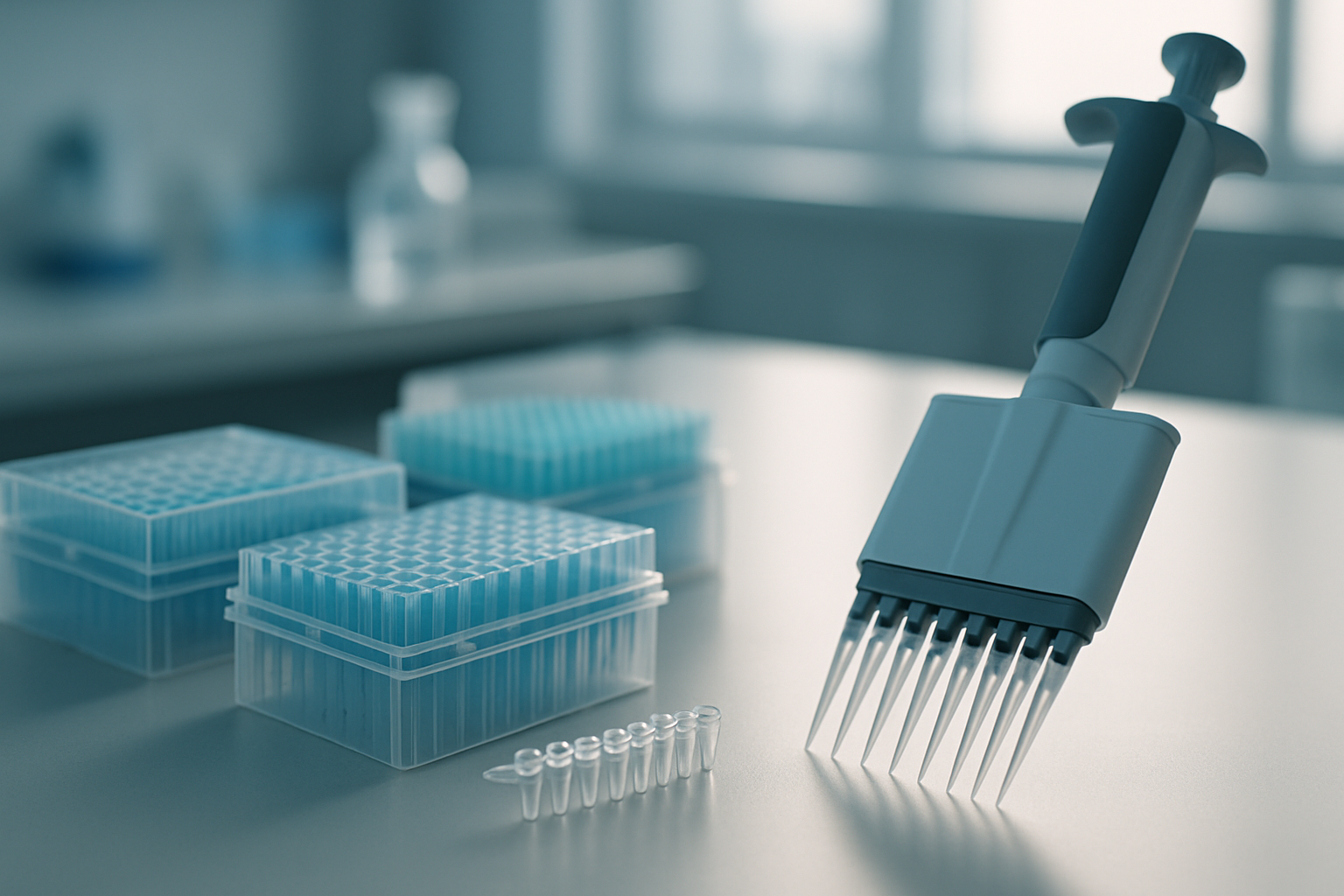
The Three Features on Every Box and What They Actually Do to Your Reaction
Filtered tips, sterile tips, low-retention tips — walk down the consumables aisle at any distributor and every box claims at least one of those. Some claim all three simultaneously. Labs buy them without thinking too hard about it because PCR feels delicate and throwing money at premium tips seems like cheap insurance.
It is sometimes. And sometimes you are paying a 40% markup for a feature that does nothing for your specific assay.
Let me break down what each property actually addresses, where it earns its cost, and where you can skip it.
Filtered Tips: The Contamination Question
The filter — usually a polyethylene frit pressed about 10–15 mm up from the barrel — exists to stop aerosols from traveling into the pipette body. When you aspirate, especially fast, a fine mist of sample rides the airstream upward. Without a barrier, that mist hits the internal seals, the piston, the ejector mechanism. It dries there. Next sample you pipette, trace nucleic acid goes right back into your tube.
For PCR, that matters enormously. A single copy of template contaminating your negative control will send you chasing ghosts for days. I have seen it happen. Last spring a customer sent back a 12-channel Rainin Pipet-Lite XLS with a complaint about erratic Cq values across the strip — turned out a technician had been running the same multichannel for both gDNA extraction cleanup and qPCR setup, unfiltered tips the whole time. The piston housing tested positive for human genomic DNA. The pipette itself had become the contamination source.
So for template-heavy work — any step where you are handling amplified product, extracted gDNA, high-copy plasmid — filtered tips are not optional. They protect the instrument as much as the reaction.
Where filters are overkill: water additions, buffer dilutions, loading non-nucleic-acid reagents. The filter adds slight back-pressure that changes your feel on a freshly calibrated pipette, and at volumes below about 2 µL you can lose 1–2% accuracy from the restriction. Not catastrophic, but real.
Sterile Tips and What Sterility Actually Guarantees (and Does Not)
Sterile, in the context of pipette tips, almost always means gamma-irradiated after packaging. The irradiation kills viable organisms. What it does not do is remove nucleic acids. Dead bacteria still contain DNA. A tip that is sterile is not automatically DNA-free, DNase-free, or RNase-free — and for PCR, especially for anything targeting bacterial sequences or doing metagenomics, that distinction is everything.
Most reputable manufacturers that sell tips as PCR-grade certify them as sterile and DNA/RNA/RNase/DNase-free. Those certifications are separate. When you are buying a bulk reload of 96-tip racks to stretch the budget, check whether the spec sheet addresses nucleic acid contamination specifically, not just sterility. They are not synonyms.
For standard PCR where your template is a well-characterized plasmid or a clean cDNA prep, plain sterile tips are usually fine. For environmental samples, food safety testing, forensic work — anything where stray environmental DNA could be your false positive — you want the full certification stack.
Practical note: once you open a rack, sterility degrades. A rack sitting open on the bench next to a PCR hood for three weeks has absorbed whatever is in your lab air. Buy in a format that matches your usage rate. The 1000-tip bulk bag that takes four months to finish probably was not worth the cost savings.
Low-Retention Tips: A Real Performance Feature, Not Marketing
Low-retention tips have a hydrophobic coating or modified polymer that reduces surface adhesion. The effect shows up most at low volumes. At 10 µL in a standard polypropylene tip, you can lose 0.2–0.5 µL clinging to the inner wall — that is 2–5% of your total volume, sitting there when you think you have dispensed everything. At 2 µL it gets worse proportionally.
For PCR master mix preparation, especially when you are dispensing expensive polymerase or a probe-based assay mix in small aliquots, low-retention tips meaningfully improve well-to-well consistency. I have run the gravimetric numbers on this. Rainin's LTS LT-200 in standard polypropylene vs. their low-retention version at 5 µL: the low-retention tip recovered an average of 0.18 µL more per dispense across 20 replicates, with tighter CV. That matters if you are running 384-well plates and your Cq is already sitting close to the limit of detection.
Where low-retention tips are less critical: anything above roughly 50 µL, viscosity-matched buffers, or situations where you are doing a mixing step immediately after — the agitation effectively dislodges the film anyway.
The one thing I will say: low-retention tips are often also sold as filtered and sterile PCR tips in the same package. That is fine. Just know you are not getting three times the protection — you are getting three separate properties that address three separate failure modes. They stack, but they do not multiply.
Building a Practical Tip Strategy for PCR Work
Most labs running routine PCR can cover themselves with a simpler matrix than they think. Here is how I would actually think about it:
- Master mix setup, adding polymerase or probe, anything under 20 µL: Low-retention, preferably filtered if the same tips are going near template. Sterile and certified nucleic-acid-free if you are doing environmental or metagenomic work.
- Adding template to reaction wells: Filtered is non-negotiable here. Always. The aerosol risk when pipetting extracted DNA is highest at this step, and cross-contamination between wells in a plate is how you get false positives nobody can explain.
- Water and buffer additions over 50 µL: Standard tips, bulk, non-filtered, save your money. You can run a Gilson PIPETMAN P200 with plain tips for this step without any measurable hit to your results.
- Post-amplification handling — gel loading, product cleanup: Filtered tips, no exceptions, full stop. Amplified product is the highest copy number DNA in your lab. One aerosol event can contaminate a pipette body for weeks.
The tip format matters too. If you are running a multichannel — Eppendorf Research plus 8-channel or any of the Rainin multichannel LTS heads — make sure your filtered tips are actually spec'd for that head. ZR-200 fits differently than LT-200. A filter tip that does not seat fully creates a gap that defeats the aerosol barrier entirely. I have watched technicians use the wrong tip family on a multichannel for months, thinking they had aerosol protection, getting none of it.
On the refurbished instrument side, this is something we pay attention to at Pipettes Guru when we recondition multichannel pipettes. We inspect the lower barrel and cone area specifically for dried aerosol residue — it is one of the things that tells us a pipette was used without filtered tips in a nucleic acid environment. If we find it, the affected seals come out. A calibration certificate does not fix a contaminated piston housing.
Budget-wise: filtered, low-retention, certified-clean tips run $18–35 per rack of 96 depending on volume range and brand. Standard non-filtered tips for the same format run $6–12. The delta is real. Spend it where the failure mode is real, skip it where it is not, and you will come out ahead on both cost and data quality.
Universal and brand-specific racks, sterile and filtered options — plus sterility-extended tips up to 80% off.
Shop pipette tips →✓ Free shipping over $500 · ✓ Fast dispatch · ✓ Bulk pricingRelated guides
- The Complete Guide to Pipette Tips (start here)
- A Complete Guide to Pipette Tip Selection for PCR Applications
Shop the range
Shop pipette tips · Sterility-extended tips (up to 80% off) · Browse the full catalog