Budget-Smart Lab Setup: Building a Complete Pipetting Station Without Overspending
By Pipettes Guru
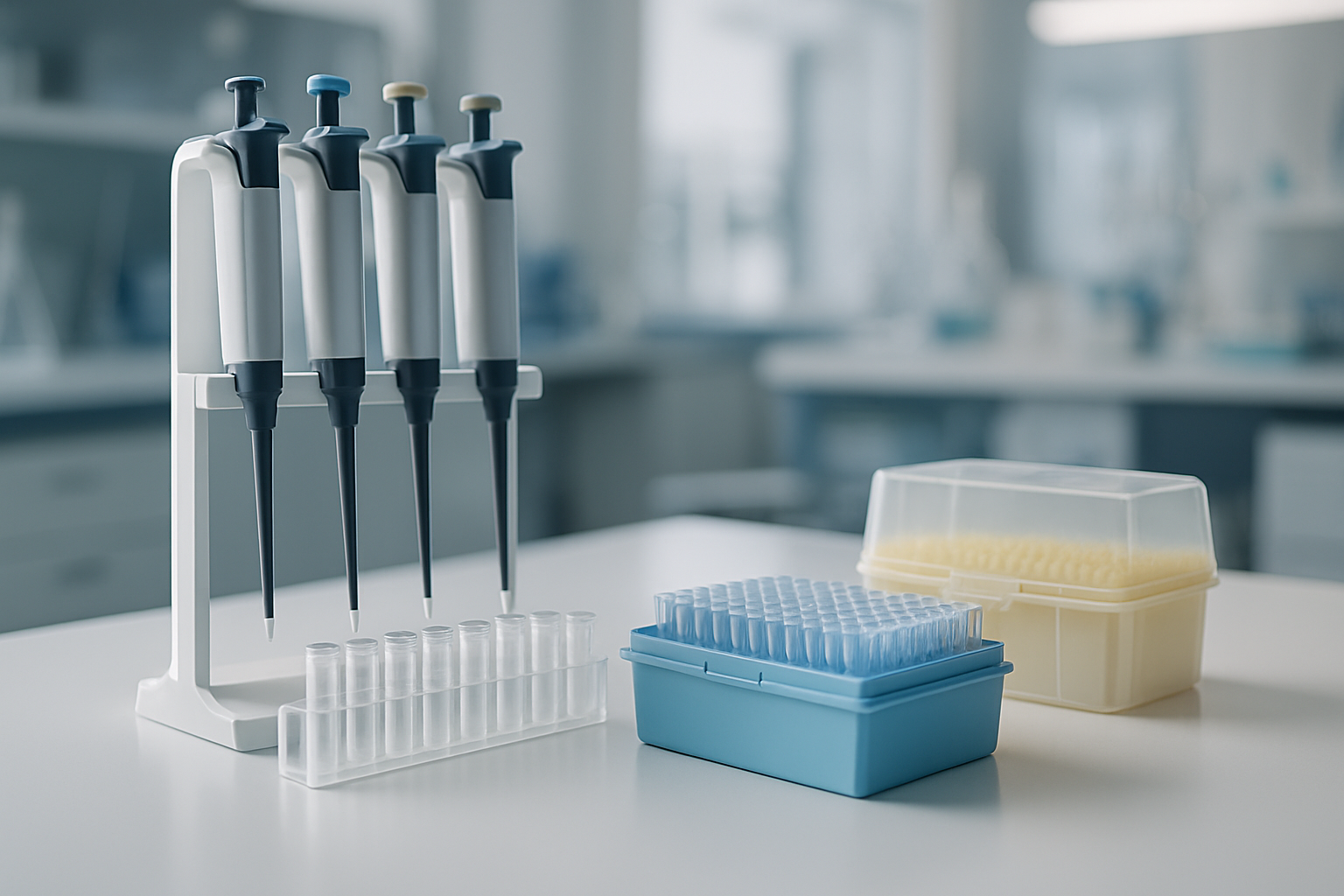
Start With the Work, Not the Wishlist
Every lab setup conversation I have with a new procurement officer starts the same way: they've got a quote from a major distributor that's eating half their annual budget before a single tube gets pipetted. A 96-well plate screening workflow, four researchers, eight-hour days — and someone's recommending four brand-new Eppendorf Research plus sets at full catalog price. I get it. The instinct is to buy new, buy once, avoid problems. But that logic breaks down fast when you price out a complete pipetting station from scratch.
The smarter move is to define the actual work first. What volumes are you pipetting daily? Are you running genomics workflows where dead-volume tips matter, or does your team do mostly cell culture transfers where a Gilson PIPETMAN Classic F1000 at 100–1000 µL is basically indestructible and costs a fraction of a top-tier electronic? Start there. Not with a catalog.
When I helped a university teaching lab set up twelve student stations last spring, the total volume range was 2–200 µL across every exercise. They nearly ordered twelve sets of brand-new Rainin Pipet-Lite XLS units — about $340 each for the single-channels alone. We stepped back, mapped the actual curriculum, and built around certified refurbished Rainin LTS-compatible instruments instead. Same ISO 8655 Part 6 calibration traceability, gravimetric verification on every unit, calibration certificates included. Final cost: 58% less than the new-instrument quote. Zero accuracy complaints all semester.
How to Actually Spec a Pipetting Station on a Budget
A complete pipetting station for a single researcher typically needs four to five single-channel pipettes covering the key volume breaks: a P2 or P10 for low-end precision work (0.5–10 µL), a P20 or P200 for mid-range, and a P1000 for bulk transfers. Add a multichannel — usually an 8-channel or 12-channel P300 — if you're doing any plate-based work. That's $800–$1,400 in new-instrument pricing just for the pipettes, before tips, stands, or any ancillary equipment.
Certified refurbished changes that math significantly. Units sourced from manufacturer trade-ins or lease returns, fully disassembled, resealed, and re-calibrated to ISO 8655-6 gravimetric tolerances, typically run 40–60% below new list price. I've seen Eppendorf Research plus 8-channel 300 µL units — new, around $520 — come through refurbishment and go out the door at $210 with the same ±1.5% systematic error specification the instrument shipped with originally. That's not a compromise. That's just procurement math.
For tips, the volume-cost relationship is worth thinking through carefully. If your workflows are non-sterile — reagent prep, teaching exercises, buffer transfers — sterility-extended tips are genuinely useful. These are tips past their labeled sterility date but covered by a manufacturer extension letter confirming structural and dimensional integrity. They meet the same LTS or universal-fit geometry specs. I've quoted labs at 60–80% off standard tip pricing for this category. For a teaching lab burning through Rainin LT-1000F tips by the case, that's a real budget line.
The Calibration Question Everyone Asks
I hear this constantly: "How do I know a refurbished pipette is actually accurate?" Fair. The answer is in the documentation, not the marketing.
ISO 8655-6 defines the gravimetric method for verifying pipette accuracy and precision. A compliant calibration report will show you the actual dispensed masses at three test volumes (typically 10%, 50%, and 100% of nominal volume), converted to µL using the Z-factor for distilled water at a stated temperature, along with calculated systematic error (Es) and random error (Cv). Any certified unit you're evaluating should come with that report. If a vendor can't give you an ISO 8655-6 compliant calibration certificate with actual gravimetric readings, don't buy the pipette.
When I see a calibration cert that just says "passed" without data, I send it back. Every time. A Gilson PIPETMAN M P200M, for example, should show Es values within ±0.8% at 200 µL and Cv ≤0.15% — those are the ISO 8655-2 Table 1 maximum permissible error values for that volume class. Real numbers. Verifiable. If the cert shows Es of 2.3% at 20 µL, that's outside tolerance and the unit needs adjustment before it ships. This is not complicated — it just requires that someone actually checked.
Where Labs Overspend (And Where They Shouldn't Skimp)
Two categories where I see procurement mistakes made in opposite directions.
Overspending: Electronic multichannel pipettes for applications that don't need them. Electronic multichannels — your Rainin E4 XLS+ 8-channel, your Eppendorf Xplorer plus 12-channel — are extraordinary tools for high-throughput workflows where variable aspiration speeds, dispense modes, and programmed sequences matter. They're $2,000–$3,500 new per unit. For a lab that's doing 96-well transfers twice a week with standard reagents, a mechanical 8-channel P300 at $180 refurbished does the job. I've watched labs spec electronics reflexively because they seem more professional. The pipette doesn't care about optics.
Underspending: Tip compatibility. This is the one I push back on hardest. Buying incompatible tips to save $8 a rack is a false economy. Rainin LTS (LiteTouch System) pipettes are designed around a bayonet-style tip connection — LTS tips like the LT-200F or LT-1000F. Run a standard universal tip on an LTS instrument and you're looking at a compromised seal, inconsistent aspiration, and accuracy drift that can hit 2–3% at the low end of the volume range. That's not a theoretical problem. I've had customers send back 12-channel LTS multichannels that were reading erratically, and the root cause was non-LTS tips being used to cut costs. Retrofit the tips. Don't retrofit the instrument.
Same principle applies to Eppendorf epT.I.P.S. with the Research plus — they're engineered for that tip geometry. Gilson PIPETMAN Diamond tips for PIPETMAN instruments. The sealing surface fit matters more than almost any other variable in day-to-day pipette performance.
What a Realistic Station Costs
To put real numbers on it: a five-pipette certified refurbished set (P2, P20, P200, P1000, plus an 8-channel P300) from quality trade-in stock, all with ISO 8655-6 calibration documentation, should run $500–$750 total depending on brand and model mix. Add a pipette stand or carousel ($25–$45), a starting tip inventory of two to three formats in sufficient quantity for a quarter's work ($80–$150 depending on volume and whether sterility-extended tips suit your application), and you're building a complete, fully calibrated pipetting station for one researcher at under $950. A comparable new-instrument station would run $1,800–$2,600.
That delta — $850 to $1,650 per station — scales fast. Ten researchers. Twenty. The certified refurbished route isn't cutting corners on science. It's cutting corners on margin that was never delivering value to your workflows in the first place.
One last thing: build annual recalibration into the budget from the start. ISO 8655 doesn't specify a recalibration interval, but most institutional SOPs and accreditation bodies want annual gravimetric verification at minimum, with interim checks for high-use or critical instruments. At $30–$60 per instrument from a calibration service, that's not a budget breaker. Not doing it is.
Every instrument is calibrated to ISO 8655, backed by a 90-day warranty, and ships with its certificate.
Shop refurbished pipettes →✓ Free shipping over $500 · ✓ 90-day warranty · ✓ Calibration certificateRelated guides
- Refurbished Pipettes: The Complete Buyer’s Guide (start here)
- The Environmental Impact of Lab Equipment: Why Refurbished Matters
- Quality Assurance in Pipette Refurbishment: What Certification Really Means
Shop the range
Certified refurbished pipettes · This week’s deals · Browse the full catalog