How to Extend the Lifespan of Your Pipettes: Maintenance Best Practices
By Pipettes Guru
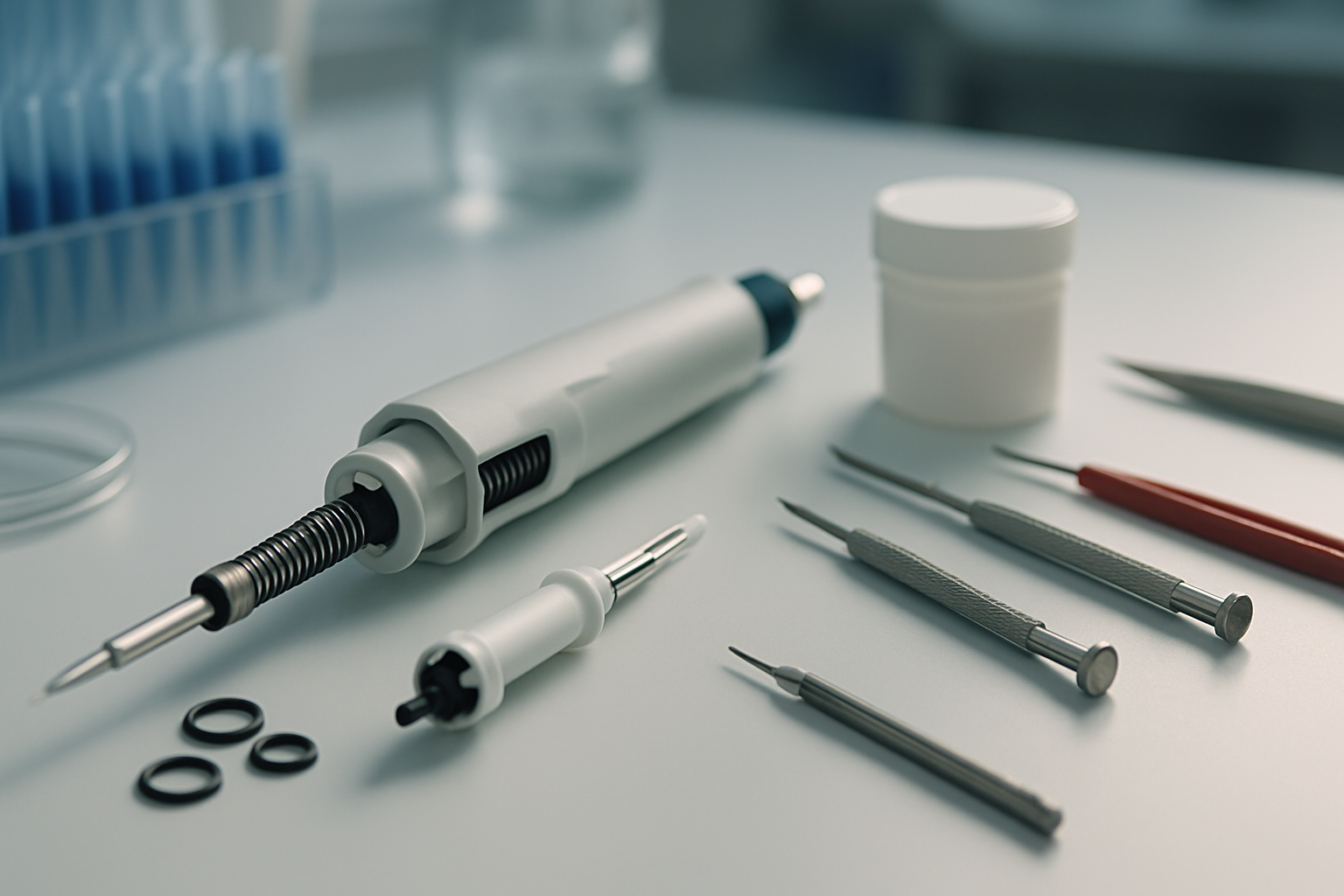
The Small Failures That Kill Pipette Accuracy (And How to Stop Them)
A worn O-ring doesn't announce itself. It just quietly costs you 2–3% at the low end of your volume range — which on a Rainin Pipet-Lite XLS set to 10 µL means you're delivering 9.7 µL when your protocol demands 10.0. That's not a rounding error. In a qPCR run or a cell viability assay, that's a failed replicate you might not trace back to the pipette for weeks.
I've been reconditioning and calibrating pipettes here for years, and the most consistent thing I see is that pipette maintenance failures are almost never dramatic. They're incremental. A technician notices the plunger feels slightly sticky but keeps using the instrument. A lab manager skips the quarterly teardown because the schedule is packed. Six months later, a gravimetric check against ISO 8655-1 shows systematic negative bias across three channels of a 12-channel, and nobody can pinpoint when it started.
Last spring a customer shipped back a 12-channel Eppendorf Research plus that had been logging 4–5% CVs at 10 µL for a month. When we disassembled it, two of the lower pistons had O-rings that had essentially fused — dried out, cracked through roughly 30% of the circumference. The rest looked intact on the surface but had lost enough elasticity that they weren't sealing reliably on the downstroke. A $40 O-ring kit and a proper cleaning would have caught this before the first bad datapoint.
Core Pipette Maintenance: What to Do, When to Do It, and What You'll Actually Need
Good pipette care runs on a layered schedule — daily habits, quarterly disassembly, and annual calibration verification. Let me break down what each layer actually looks like in practice, not in theory.
Daily and Weekly
Wipe down the exterior barrel with 70% isopropanol after each session if you're working with biological material or anything viscous. Don't spray directly — dampen a lint-free wipe. Ejector arms on instruments like the Gilson PIPETMAN Classic and the Rainin LTS series can accumulate residue at the joint, which over time stiffens the mechanism and adds inconsistent tip ejection force. That inconsistency is surprisingly common and surprisingly easy to miss.
Check your tips. This sounds obvious, but fit matters more than most people acknowledge. An LTS LT-1000 tip is machined for a specific cone geometry. Using a universal tip on an LTS mount introduces an air gap that shows up immediately in your gravimetric readings. I've seen labs swap to a cheaper universal tip to save money and end up burning that savings (and more) on repeat runs and out-of-spec data.
Quarterly Disassembly and O-Ring Replacement
This is where most labs underinvest. A quarterly teardown on each pipette in your fleet takes about 15 minutes per instrument if you're comfortable with it — maybe 25 your first few times. What you're looking for:
- O-ring condition: Any flattening, cracking, tackiness, or visible deformation means replacement. Don't try to extend a marginal O-ring. The part costs almost nothing relative to a failed experiment.
- Piston surface: Light oxidation is normal. Scoring, pitting, or anything that catches your fingernail is not. A scored piston on an Eppendorf Research plus or a Gilson F-series will wear through a new O-ring in weeks.
- Spring tension: Compare the feel of the plunger against an instrument you trust. Fatigue in the return spring is subtle but causes inconsistent aspiration volumes, particularly at the bottom of the range.
- Lower shaft / tip cone: Inspect under magnification if you have it. Hairline cracks at the base of the cone are a common failure point on older instruments, especially if tips are mounted with excessive force.
Use manufacturer-supplied lubricant — not a generic silicone grease, not WD-40, nothing you grabbed from a drawer. Rainin ships a small grease packet with their service kits. Eppendorf recommends their own formulation for the Research plus piston. The viscosity and compatibility are matched to the tolerances these instruments are built to. Cross-lubricating is a fast path back to O-ring degradation.
O-ring replacement is the single highest-ROI maintenance step in pipette care. If you're doing quarterly teardowns and replacing O-rings annually (or immediately when you see wear), you'll extend instrument life by years. We've reconditioned Gilson PIPETMAN Classic units from the early 2000s that still hold ISO 8655-6 compliance after a proper service — because someone maintained them.
Calibration Verification: What ISO 8655 Actually Requires
ISO 8655-6 specifies gravimetric testing as the reference method for verifying volumetric performance. In practice, that means a calibrated analytical balance (at least 0.001 g readability for volumes below 100 µL), distilled water at a known temperature, and enough replicates to calculate both systematic error (bias) and random error (CV).
The standard sets maximum permissible errors by volume. At 10 µL on a single-channel instrument, you're working with tolerances of ±3.0% for systematic error and 1.5% for random error under ISO 8655-2. At 1000 µL, those tighten to ±0.8% and 0.15%. These aren't suggestions. If your instrument is out of tolerance, your downstream data is compromised — period.
Annual calibration by an accredited service is the standard expectation for GLP/GMP environments. But between formal calibrations, in-house gravimetric spot checks quarterly — particularly after any mechanical event like a drop or a forceful tip ejection — will catch drift before it contaminates a dataset. A 10 µL check at the nominal volume and at 20% of nominal (2 µL on a 10 µL pipette) covers the range where problems show up first.
Document everything. Date, operator, balance ID, water temperature, and the calculated bias and CV for each measurement. If you're ever asked to defend a dataset, that log is your first line of evidence.
Buying Decisions That Affect Longevity Before You Ever Open the Box
How you acquire instruments matters as much as how you maintain them. A well-maintained pipette outlasts a neglected one regardless of purchase price — but starting with a quality instrument on a realistic budget is its own form of maintenance planning.
Certified refurbished pipettes from a reputable supplier are calibrated to the same ISO 8655 accuracy standards as new instruments and typically cost 40–60% less. We recondition Rainin, Eppendorf, and Gilson instruments to full specification — new O-rings, piston inspection, gravimetric verification — before they leave. For a teaching lab or a startup equipping a new bench, that's a meaningful budget difference that doesn't compromise data quality.
On the consumable side: if you're running non-sterile protocols or training exercises, sterility-extended pipette tips — tips past their labeled sterility date but covered by a manufacturer extension letter — perform identically for volumetric purposes at 60–80% off standard pricing. The geometry, material, and fit are unchanged. Sterility is the only variable, and for PCR cleanup, reagent prep, or training workflows, it's irrelevant. Use the savings to fund your maintenance kit.
The instruments that last in my experience aren't the newest or the most expensive. They're the ones where someone on the team treats the teardown schedule like a real deadline, replaces O-rings before they fail, and runs a gravimetric check after anything unusual. That's it. No exotic technique required — just consistency and the right parts on hand before you need them.